
A motorway breakdown is a safety situation before it is a transport booking. Your first task is to follow official guidance and get appropriate help, rather than completing a quote form beside moving traffic. Once you can safely communicate, an accurate location and a clear account of the vehicle's condition help the recovery team understand the request. This guide separates the immediate safety decisions from the information needed for a commercial recovery assessment.
If you cannot get to safety, call 999
If the vehicle is stranded in a live lane, or you cannot leave it safely and reach a position away from moving traffic, keep seatbelts fastened and hazard lights on and call 999 immediately, asking for the police. Use the vehicle's SOS facility if appropriate. Do not wait for a recovery quote in this situation.
Tell the emergency operator your road, direction and what has happened. Follow their instructions, including any advice for passengers who cannot exit safely. The recovery team does not replace the emergency services or manage a live traffic lane.
Use official guidance for a breakdown away from a live lane
If the vehicle develops a problem and it is possible to do so, the Highway Code advises leaving at the next exit or reaching a service area. Otherwise, move left to an emergency area or hard shoulder if you can. Hazard lights help alert others.
Exit on the side furthest from traffic only when it is safe and possible. Keep well away from the vehicle and traffic, behind a barrier where available and safe, watching for hazards beyond it. Use an emergency telephone for assistance when appropriate, and follow the operator's advice.
Do not turn the hard shoulder into a repair area
Official motorway breakdown guidance advises against attempting repairs and placing a warning triangle on the carriageway. A flat tyre, a loose component or a car that appears easy to restart still needs a safe response to its location. Do not return to the vehicle simply to gather quote information or a photograph.
Where a road authority, police officer or emergency telephone operator is managing the incident, follow their instructions. If you are in an emergency area, the Highway Code requires you to use its emergency telephone and follow advice before rejoining the carriageway.
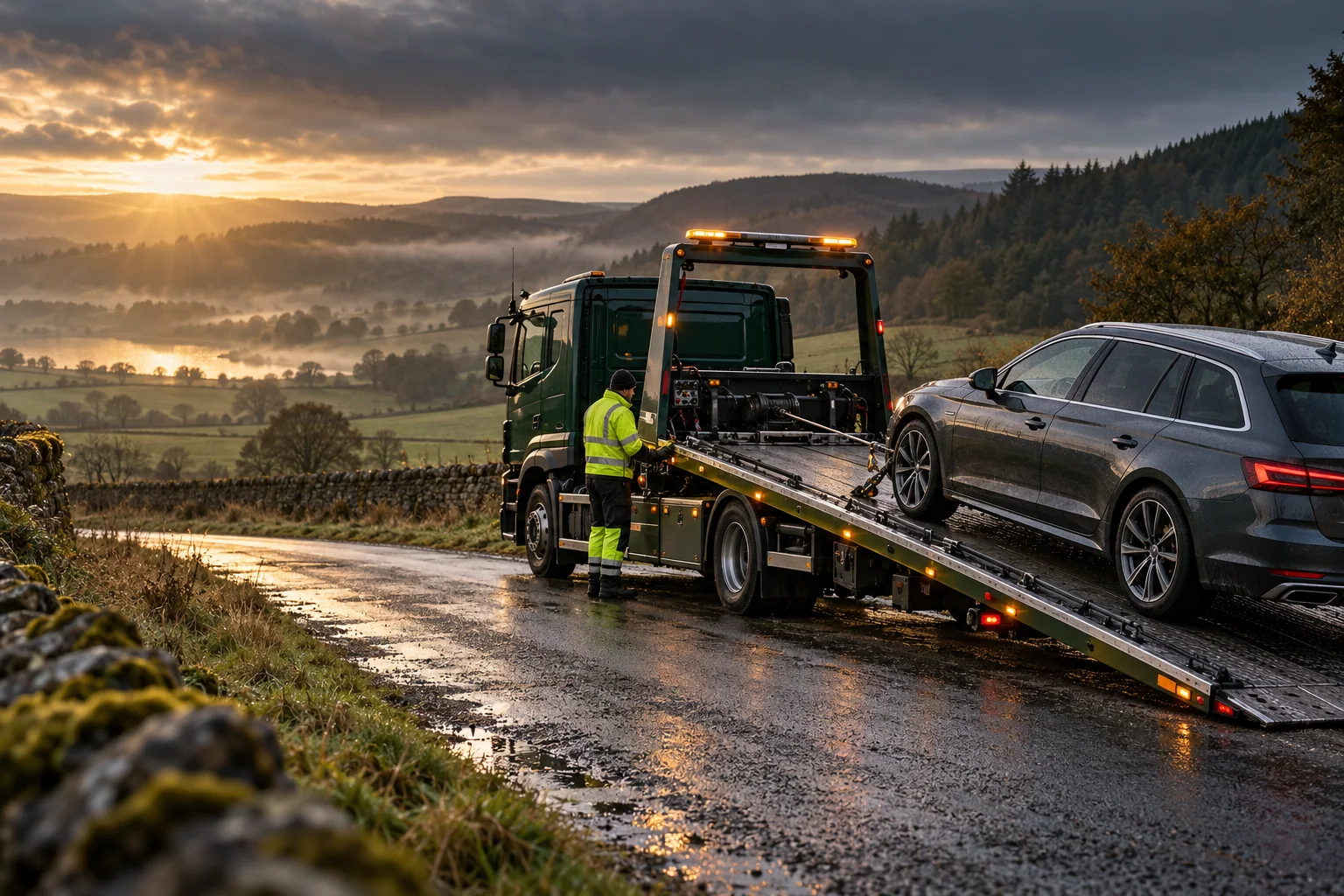
Describe your location precisely
For a recovery request, a motorway number and the name of a nearby town leave too much uncertainty. Add the direction of travel and whether the vehicle is in a service area, emergency area, hard shoulder or another location. A service area's name and the correct carriageway are particularly useful.
Share a current-location pin if you can do so safely. Existing driver-location signs or marker information may also help; do not walk along the motorway looking for them. If you are already away from the vehicle, explain that the phone's location may describe where you are waiting rather than the car itself.
Explain what needs recovering
Give the make, model and transmission, then describe the problem in plain language. Identify an electric or hybrid vehicle, a van with a load, a trailer, visible collision damage or a damaged wheel. Say whether the vehicle can roll, select neutral and release its parking brake if those facts are already known.
You do not need to inspect the vehicle beside traffic or perform a test to answer these questions. Tell the team when a detail is unknown. Accurate limitations are more useful than an unsafe attempt to prove that the car can move.
Agree the destination and passenger arrangements
If you want onward vehicle recovery, provide a destination postcode or full address. Check whether the garage, home or other recipient can accept the vehicle, including any opening-hour or unloading restrictions. If you have not yet decided on a destination, explain that before a transport price is discussed.
State how many people are travelling and mention any mobility or access needs. Confirm passenger arrangements directly rather than assuming every recovery vehicle can accommodate your party. Let the team know if another person is arranging collection so the contact and access details are clear.
Use the quote form only when it is safe
Once the immediate safety situation has been dealt with, use the form to send the location, vehicle details and delivery information. Choose your preferred contact method and keep your phone available for a response. Sending a request is not confirmation of an assigned truck; price, availability and collection arrangements need agreeing.
For route information, use the motorway recovery section. For wider recovery planning, read the pricing guide. Conditions and traffic change, so any attendance estimate should come from the team handling your specific enquiry.
Useful recovery questions
Should I complete a quote form if I am stuck in a live lane?
No. Keep your seatbelt and hazard lights on and call 999 immediately, asking for the police. Follow the emergency operator's instructions.
Can I change a tyre on the motorway hard shoulder?
Follow official motorway breakdown advice, which tells drivers not to attempt repairs. Get appropriate assistance rather than carrying out a roadside tyre change.
Is a nearby postcode enough to identify my motorway location?
Add the motorway number, direction and the actual stopping place. A postcode alone may identify the wrong carriageway or a road that cannot access your vehicle.
Should I take photos of the vehicle for a motorway quote?
Only send existing or safely available information. Do not walk beside traffic, return to a hazardous position or delay an emergency call to take photographs.
Does sending the form confirm a recovery booking?
No. The team must review the request and agree the price, availability and collection arrangements. Keep your contact details accurate and your phone available.
What if I cannot safely leave the vehicle?
Stay belted with hazard lights on, call 999 immediately and explain the situation. This also applies when a disability prevents you following the usual exit advice.